
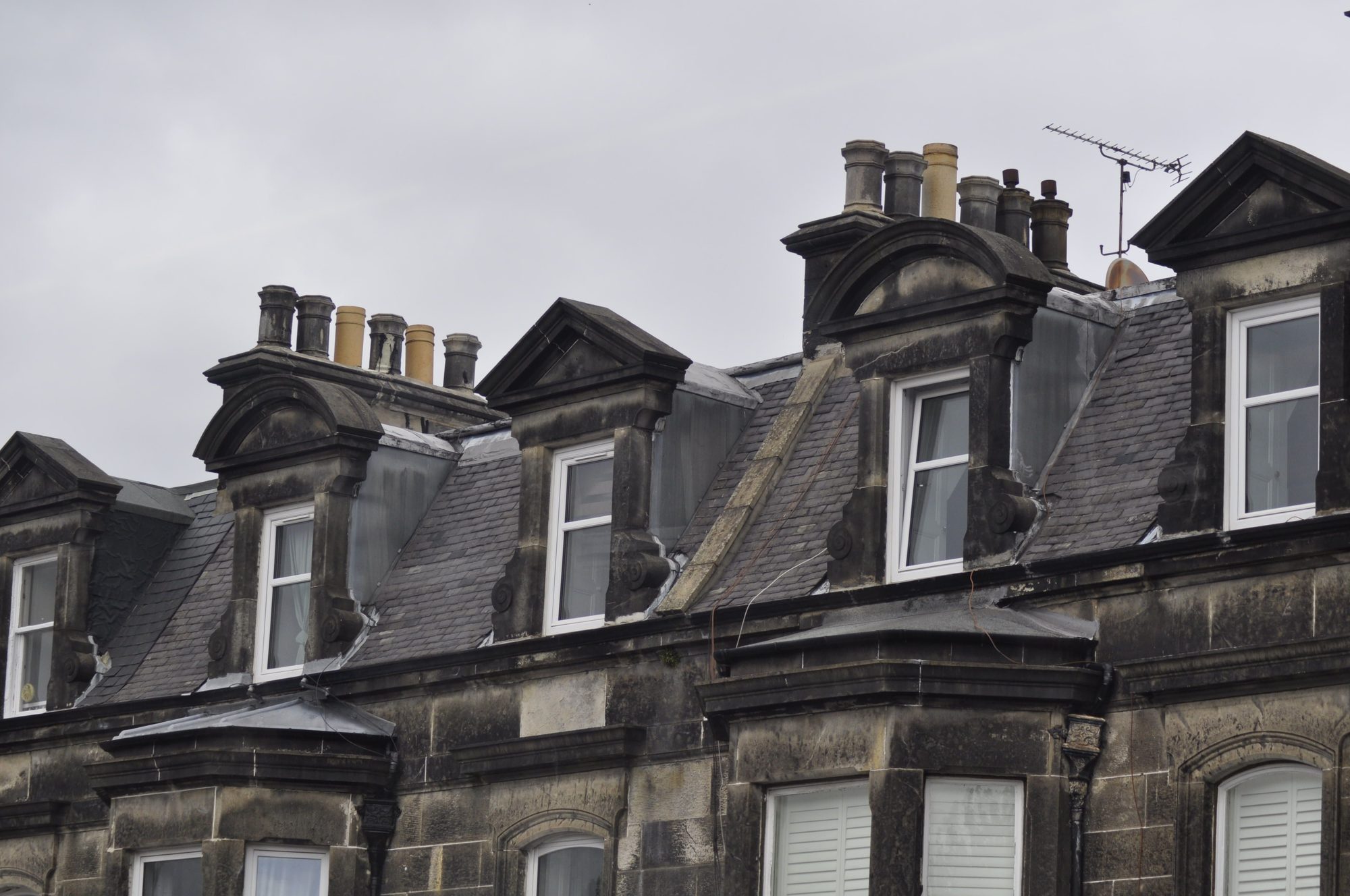
Why does lead flashing fail on a slate roof?
Lead flashing weatherproofs the junctions a slate covering alone cannot, around chimneys, dormer cheeks, valleys and abutments against walls. Common causes include flashings working loose from the mortar joint (the raggle) they are tucked into, lead that is too thin for the job, and damage or theft. Historic Environment Scotland’s advisory standards set out the thickness of lead expected for each kind of flashing on a historic building.1
A great deal of what looks like a slate problem, a damp patch near a chimney breast or water tracking down inside a dormer cheek, actually starts at a flashing junction rather than in the slates themselves. Getting the diagnosis right matters, because the repair is quite different. Historic Environment Scotland’s guide to Scottish slate roofs explains how the parts of a slate roof fit together.2
Common flashing failure points
- Chimney stacks. The flashings where a chimney passes through the slates, including the gutter behind the stack, are one of the most common sources of water getting in on older roofs. See our chimney repairs guide.
- Dormer cheeks and heads. Dormers bring several vertical and sloping junctions into a short space, each needing its own flashing.
- Valleys. Where two slopes meet at an internal angle, lead lined valleys carry a concentrated flow of water and wear at the point of greatest flow.
- Abutments. Where a roof slope meets a rising wall, such as a taller neighbouring building.
What thickness of lead should be used?
Sheet lead is graded by “code”, with a higher code meaning thicker lead. Historic Environment Scotland’s advisory standards for historic buildings in Scotland recommend:1
| Where the lead is used | Recommended code |
|---|---|
| Flashings, secret gutters and dormer cheeks | Code 6 |
| Valleys | At least code 7 |
| Short gutters or small flat roofs without foot traffic | At least code 7 |
| Other flat roofs, or gutters on a geotextile underlay | Code 8 |
| Ridges | Code 8, fixed with lead or stainless steel clips |
| Cupola, astragal and rooflight cover flashings | At least code 5 |
The same standards say lead should be laid following the recommendations of the Lead Sheet Association while respecting the look of the original leadwork, that flashings should be set into raggles deep enough to be pointed with lime mortar, that the lead should be protected from direct contact with the lime mortar, and that sacrificial flashings are encouraged where slates discharge into valleys and parapet gutters.1
Rules for listed buildings and conservation areas
City of Edinburgh Council’s guidance for householders says most ridges and flashings on listed buildings and in conservation areas should be replaced in lead, using the correct code.3 Swapping lead for a different material on a listed building may need listed building consent. Our planning and listed building guide explains when consent is needed.
Replacing a roof covering with material of the same general type, to a standard no worse than before, is generally listed as work that does not need a building warrant, but the finished work must still meet the building regulations.4
Lead theft
Historic Environment Scotland describes metal theft, especially of lead from roofs, as the biggest single threat to historic buildings in Scotland, and points out that once a roof is stripped, water damage can follow quickly.5 If lead has gone missing, a temporary weatherproofing repair is usually the first priority.
Working safely with lead
The Health and Safety Executive lists working with lead on roofs among the construction tasks that can expose workers to lead, which can cause serious health problems. It advises controls such as avoiding hot cutting where possible, keeping hot air guns below 500°C, and providing proper washing facilities.6 The legal duties are set out in the Control of Lead at Work Regulations 2002.7
Shared roofs in tenements
Flashings are part of the roof. Unless the title deeds say otherwise, the Tenement Management Scheme treats a tenement roof as scheme property, so repairs are decided and paid for by the owners together.8 Our tenement shared repairs guide explains how that works.
What a small repair can and cannot fix
A small, localised flashing repair, such as re-dressing a piece of lead that has come loose or re-pointing a flashing back into its raggle, is within the scope of the small slate and detail repairs we take on. A full renewal of the lead around a chimney stack, or re-leading valleys and abutments across a whole roof, is a larger job that we do not carry out ourselves. Where that is what a roof needs, our full roof replacement guide explains how we point you towards someone suitable.
Think a flashing junction might be the real problem?
Email us photos of the roof and what floor it’s on, or how many levels up it is, and we’ll tell you what we need to give you a price.
How to contact usSources
- Historic Environment Scotland, Advisory Standards of Conservation and Repair for the Historic Building Environment in Scotland, s 3.5 (Leadwork). historicenvironment.scot
- Historic Environment Scotland, Inform Guide: Repairing Scottish Slate Roofs (2006). historicenvironment.scot
- City of Edinburgh Council, Listed Buildings and Conservation Areas: Guidance for Householders, ‘Rainwater goods’. edinburgh.gov.uk
- Scottish Government, Building Standards Technical Handbook 2022: Domestic, s 0.5 (Building (Scotland) Regulations 2004, reg 5 and sch 3). gov.scot
- Historic Environment Scotland, ‘Examples of heritage crime’. historicenvironment.scot
- Health and Safety Executive, ‘Construction hazardous substances: Lead’. hse.gov.uk
- Health and Safety Executive, Control of Lead at Work (L132, 3rd edn). hse.gov.uk
- Tenements (Scotland) Act 2004, sch 1 (Tenement Management Scheme), r 1.2. legislation.gov.uk